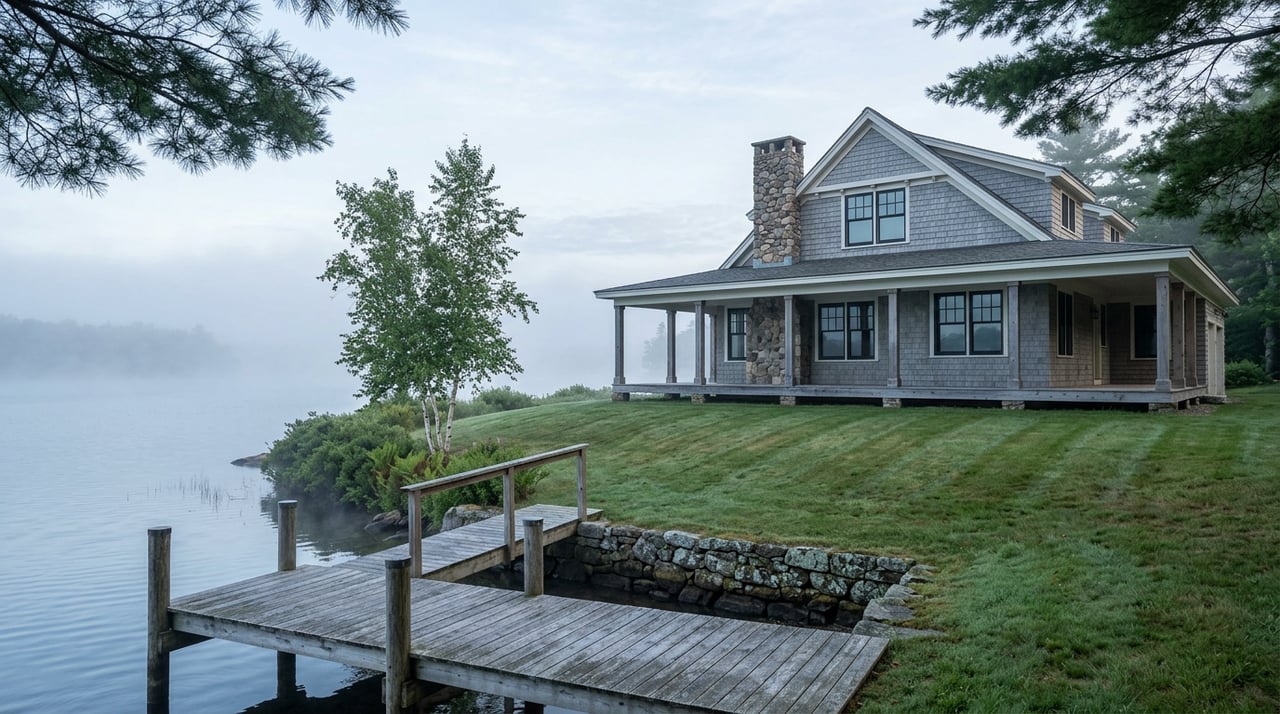
In Wolfeboro, the Lake You're On Decides How Big Your Dock Can Be
Say you're under contract on a waterfront property on Crescent Lake in Wolfeboro, and the seller's disclosure mentions the dock will need to be rebuilt before next season. You've already seen a nearly identical listing close on Lake Wentworth, a few miles away, same town, same permitting agency, same paperwork. You assume the replacement dock will look the same. It won't. The lake decides the math, and in Wolfeboro, that's the part almost nobody checks before they write the offer.
Wolfeboro is unusual among Lakes Region towns because it doesn't sit on one body of water. It has frontage on Lake Winnipesaukee, on Lake Wentworth, and on Crescent Lake, which connects to Wentworth through the Smith River near Mass Landing. Three shorelines, one town line, and two different sets of state size thresholds that quietly split the rulebook depending on which acreage bracket your particular lake falls into. For a buyer or seller working a transaction on Wolfeboro water, that split shows up in the size of the dock you're allowed to build, the boat slip you're allowed to keep, and how much runway you need before closing.
New Hampshire's dock rules aren't written per town. They're written per lake, based on acreage, and the state has set two thresholds that happen to land right in the middle of Wolfeboro's shoreline.
The first threshold is 10,000 acres, and it governs how big a boat slip can be. On any waterbody of 10,000 acres or less, a boat slip is defined as a volume of water 20 feet long, six feet wide, and three feet deep. On anything larger, the slip grows to 25 feet long, eight feet wide, and three feet deep. Only one lake in New Hampshire crosses that line: Lake Winnipesaukee, at roughly 44,586 acres. Lake Wentworth, at about 3,097 acres, and Crescent Lake, at around 147 acres, both fall under the smaller standard.
The second threshold is 1,000 acres, and it governs the maximum length of a seasonal dock. On waterbodies at or above 1,000 acres, a seasonal dock can run up to 6 feet wide by 40 feet long. Below that acreage, the cap drops to 6 feet wide by 30 feet long. Winnipesaukee and Wentworth both clear the 1,000-acre bar. Crescent Lake, at under 150 acres, does not.
Line those two thresholds up against Wolfeboro's three shores and you get a pattern that surprises people who assume "Wolfeboro waterfront" is one product:
| Waterbody | Approx. acreage | Boat slip size | Max seasonal dock |
|---|---|---|---|
| Lake Winnipesaukee | 44,586 | 25 ft x 8 ft x 3 ft | 6 ft x 40 ft |
| Lake Wentworth | 3,097 | 20 ft x 6 ft x 3 ft | 6 ft x 40 ft |
| Crescent Lake | 147 | 20 ft x 6 ft x 3 ft | 6 ft x 30 ft |
A seasonal dock on Wentworth can legally be a third longer than the one on Crescent Lake, even though both are Wolfeboro addresses with docks feeding into the same connected water system. And a buyer moving from a Wentworth property to a Winnipesaukee one gets a meaningfully bigger boat slip standard, not because Winnipesaukee is more permissive as a matter of local custom, but because it's the only lake in the entire state that crosses the 10,000-acre line. Full detail on how the state defines these dimensions is in the permitting fact sheet for freshwater docking structures.
None of this is a Wolfeboro ordinance. It's state law applied unevenly across a town that happens to touch three lakes in three different size classes. That's the part worth sitting with before you assume a dock plan transfers from one shoreline to another.
Older docks on any of these three lakes often predate the current rules, and that history matters more than most buyers realize. State guidance draws a line at seasonal structures built before September 4, 1978, and a separate line for shoreland structures within 50 feet of the water built before November 26, 1996. Structures that predate those dates can carry grandfathered status, which can let them keep a footprint or configuration that wouldn't be approved if someone applied for it fresh today.
That protection is narrower than it sounds. It covers the structure as it exists. It doesn't automatically transfer to a rebuild in a different footprint, and repairs that change size, location, or configuration typically require a new wetlands permit even if the original dock predates every current rule. If you're buying a property with an older dock on any of Wolfeboro's three shores, the question isn't just "is there a dock." It's whether the seller has the permit history and construction date documentation to prove grandfathered status, because that paperwork, not the dock's current appearance, is what determines what you're allowed to do with it once you own it. The state's docking structures and shoreline stabilization page is the starting point for tracing that history.
There's a second piece of this that has nothing to do with dock size and everything to do with timing. Under RSA 485-A:39, any developed waterfront property with an on-site septic system contiguous to or within 200 feet of the water needs a completed site assessment study before it can be sold. Wolfeboro's own zoning code, in the Shorefront Residential District section, references this same requirement directly, which means it isn't a state formality sitting off to the side. It's baked into how the town treats a waterfront sale.
This is the kind of requirement that doesn't announce itself at the listing appointment. It shows up when a buyer's attorney or lender asks for it during due diligence, sometimes with only a few weeks left before closing. A site assessment study takes time to schedule and complete, and if a seller on any of Wolfeboro's three lakes hasn't already arranged one, it can push a closing date back by weeks. Sellers who get this scheduled early, before the property goes live, avoid the scramble entirely.
One more piece is recent enough that it hasn't fully worked its way into every buyer's due diligence checklist yet. New Hampshire's House Bill 99 took effect on July 13, 2025, and it requires anyone anchoring a floating dock, seasonal platform, inflatable platform, or float on public waters to meet requirements set by the state Department of Safety. That's a meaningful shift for a category of waterfront equipment that, until recently, sat somewhat outside the standard wetlands permitting conversation.
If you're buying on Winnipesaukee, Wentworth, or Crescent Lake and the property comes with a floating platform or an anchored swim float that predates mid-2025, it's worth confirming whether that setup has actually been evaluated against the new anchoring standard, rather than assuming it was grandfathered in by default. The rule is young enough that plenty of existing installations haven't been checked against it yet. NH LAKES keeps a running summary of this and related state legislation affecting lake property that's worth a look before you assume an existing setup is compliant.
Wolfeboro's waterfront inventory has stayed active through the year. As of early September 2026, there were 17 waterfront homes listed in town at a median price around $795,000, with most homes in Wolfeboro spending roughly 68 days on market before selling. That's enough live inventory that these three frictions, dock size thresholds, grandfather documentation, and the pre-sale septic assessment, aren't edge cases. They're a normal part of closing on Wolfeboro water this season, on any of its three lakes.
Before you write an offer or take a listing on Wolfeboro waterfront, a few questions are worth asking up front rather than discovering mid-transaction:
None of these questions are complicated once you know to ask them. The trouble is that most waterfront checklists treat Wolfeboro as a single market instead of three, and the town's own geography is exactly what makes that assumption expensive.
If you're weighing a purchase or a sale on Winnipesaukee, Wentworth, or Crescent Lake and want to walk through what your specific frontage allows before you're locked into a contract, Gail McCarthy has spent years working both sides of New Hampshire waterfront transactions and can help you sort out what applies to your shoreline before it becomes a closing-week surprise. Let's Connect.
This article is general information, not legal, tax or financial advice. Consult a qualified professional about your situation.
From the first conversation to closing day, Gail delivers thoughtful guidance, responsive communication, and a high level of professionalism. Her experience in both property ownership and brokerage gives clients a practical, informed perspective that helps them move forward with greater confidence.
23 BARBERRY ST HOOKSETT, NH 03106 MON - SUN, 9 AM - 5 PM OR BY APPOINTMENT