Hooksett Rents, Zoning, and New Multifamily Rules
If you're pricing a small multifamily purchase in Hooksett this fall using the last few years of rent growth as your baseline, you're building your numbers on a trend that's already starting to break. The gap between what a two-bedroom rents for in Hooksett and what the same unit rents for a few miles south in Manchester has been wide enough to notice for a while. Most explanations point to demand: commuters priced out of Boston, families wanting a Merrimack River address, the usual southern New Hampshire story. But demand doesn't explain the premium.
The bigger driver is one document: a zoning board variance, granted back in May 2025, for a single building on Route 3.
Hooksett's asking rents have been running noticeably above Manchester's citywide average. Manchester's average rent sat at $1,950 a month as of September 2026, and other trackers have put it closer to $1,995 that same month. Hooksett's asking rents, by comparison, have clustered well above $2,000, with some listings services putting the median closer to $2,400 to $2,500.
That's a meaningful spread for two towns that share a border, a highway, and much of the same commuter base. Manchester has more housing stock, more density, and a wider range of unit types, all of which should push its rents up relative to a smaller town like Hooksett, not down. The fact that Hooksett commands a premium anyway tells you something about supply, not just about who wants to live there.
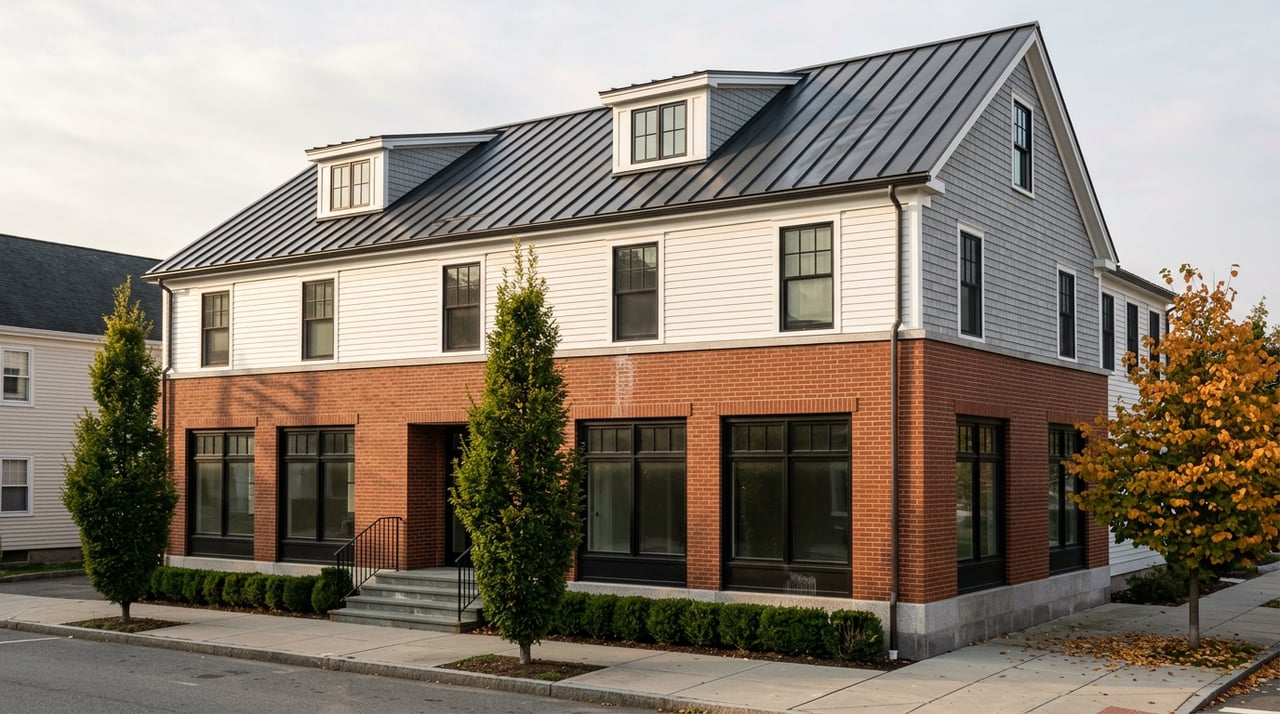
The clearest evidence sits at 2 College Park Drive, the former Cigna office building on Hooksett's Route 3 corridor. In 2025, a developer proposed converting the site into as many as 160 units, roughly 80 apartments inside the existing building and 80 new townhouse units on the surrounding parking lot, with two small retail or restaurant buildings facing the road. As NH Business Review reported, that project only moved forward after the developer secured a variance from the Hooksett Zoning Board of Adjustment.
A variance is not a formality. It means the underlying zoning did not permit that use as a matter of right. Someone had to make a case, in front of a board, for permission to do something the ordinance otherwise blocked. That's the friction that's been rationing new multifamily supply in Hooksett's commercial corridors for years: not a lack of sites, but a rule that made every conversion a negotiation rather than a checklist.
The same corridor shows the pattern from the investment side. A fully leased 30,000-square-foot commercial property at 1134 Hooksett Road sold this year to an out-of-state investor making his first New Hampshire acquisition, brokered by NAI Norwood Group. A separate active listing assembles three adjoining Hooksett Road parcels under the town's Performance Zone designation, marketed directly to investors and builders looking for redevelopment potential. Capital wants in on this corridor. What's been scarce is the zoning permission to do more with it than what's already built.
That's changing, and it changed on a specific date. New Hampshire's HB 631, passed in 2025, created RSA 674:77-78, which requires every municipality in the state to allow multifamily housing on commercially zoned land where water, sewer, and other infrastructure can support it. The requirement took effect July 1, 2026.
Towns did not receive that mandate quietly. Some responded by adding density caps, landscape buffer requirements, and conditional use permits designed to keep the same discretionary control they'd always had, just wrapped in new language. New Hampshire lawmakers noticed, and on July 15, 2026, Governor Kelly Ayotte signed a follow-up bill, HB 1588, that closed those workarounds. It took effect retroactively, one minute after the original law, and made clear that qualifying housing in commercial zones is allowed "by right," not by the town's discretion. A legal analysis of the change called it one of the most significant statewide shifts in New Hampshire's zoning landscape in decades.
The practical effect for a town like Hooksett: the discretionary step that turned the 2 College Park Drive project into a variance case is no longer the default gate for new multifamily proposals on qualifying commercial land. The path is shorter and more predictable, which means the pace of new supply on corridors like Route 3 should pick up.
Hooksett's own March 2026 town meeting ballot dealt with this directly. Voters weighed seven zoning amendments, including one bringing the town's Mixed-Use 1 District into compliance with a related state statute, RSA 674:80, governing multifamily housing paired with ground-floor retail. Two other items on that same ballot matter for anyone underwriting property in town: a new allowance for detached accessory dwelling units up to 750 square feet, and a change aligning Hooksett's septic setback rules with the state's minimum instead of the town's stricter 15-foot buffer. Both quietly increase the number of lots that can support an additional unit.
None of those seven amendments individually created a construction boom. Together, they describe a town adjusting its rulebook to a state mandate it no longer has the option to ignore. Whether any single amendment passed or failed at the ballot box matters less than the larger point: the state closed the loophole towns were using to slow this down, and Hooksett's own process shows the town preparing for that reality rather than fighting it.
Trailing rent comps in Hooksett reflect a period when some multifamily proposals on commercial land required a discretionary variance. The new law changes the approval path for qualifying commercial land where infrastructure can support the additional units. A 160-unit project already moving through the approval process, on a single Route 3 parcel, is a meaningful addition relative to the town's existing rental stock, and it's the kind of project the new law is designed to make easier to replicate on other qualifying commercial parcels where infrastructure can support the additional units.
That doesn't mean Hooksett becomes a weak market overnight. It means the scarcity premium baked into the last few years of rent growth is not guaranteed to hold, and a pro forma built on continuing that trend is riskier than it looks. Compare your target property against Manchester's already-established multifamily fundamentals, cap rates running between 5.25% and 5.75% as of 2026 and vacancy near 4.8%, since Hooksett doesn't yet have its own separately reported series for either figure. The absence of that data is itself a signal of a market that's been thinner and more discretion-driven than its larger neighbor.
Carrying costs matter here too. Hooksett's 2025 property tax rate was $17.19 per $1,000 of assessed value, a figure worth running against your actual offer price rather than a townwide average, the same way you'd check any New Hampshire town's rate before finalizing numbers.
Does the new state law apply to every commercial parcel in Hooksett? Only where the town's infrastructure, water, sewer, and related capacity can support the additional units. A parcel without adequate service access doesn't automatically qualify just because it's zoned commercial.
Does this affect existing single-family neighborhoods? No. RSA 674:77-78 and the follow-up HB 1588 apply to commercially zoned land. Residential zoning districts are governed separately, and this legislation does not rezone single-family neighborhoods.
If I'm buying an existing multifamily building rather than developing new units, does any of this matter to me? It matters for your rent growth assumptions and your exit cap rate more than for your day-to-day operations. New supply on nearby commercial parcels changes what comparable units can command over your hold period, which is exactly the number a buyer three or five years from now will be underwriting against.
Hooksett rewards the kind of client who wants to understand the mechanism behind a number, not just the number itself. If you're weighing a multifamily purchase here, or trying to figure out what a Route 3 corridor parcel is actually worth under the new rules, REEN USA brings direct ownership and syndication experience to that conversation, not just a listing sheet. Let's Connect.
This article is general information, not legal, tax or financial advice. Consult a qualified professional about your situation.
From the first conversation to closing day, Gail delivers thoughtful guidance, responsive communication, and a high level of professionalism. Her experience in both property ownership and brokerage gives clients a practical, informed perspective that helps them move forward with greater confidence.

23 BARBERRY ST HOOKSETT, NH 03106 MON - SUN, 9 AM - 5 PM OR BY APPOINTMENT