Auburn's Lake Massabesic Bans Swimming. That's Exactly Why the Best Walk of the Year Is Happening Right Now.
Why does the biggest body of water in Auburn belong to almost nobody who actually touches it?
The town just closed out its one big communal day of the year. On September 12, Hooksett Road shut down between Raymond Road and Eaton Hill Road for the parade that opens Auburn Day and the 33rd Annual Duck Race, with food trucks, a petting zoo, and a Black Hawk helicopter parked in a field behind the AVS school for anyone who wanted a closer look. Tickets for the Duck Race, sold at the Griffin Free Public Library and the Auburn Historical Association booth, carried a $1,000 top prize. It is the kind of event that fills the calendar for one Saturday and then lets the season go quiet again.
What fills that quiet stretch, for most people who actually live here, is not a lake day. It is a walk around one.
Lake Massabesic covers 2,560 acres along Auburn's western edge, and almost none of that water is legally available to swim in. The rule is not new. The Manchester Water Works claimed the lake as the city's primary drinking supply in 1870, and that single administrative decision rewired what the lake has meant to the people around it ever since.
Before 1870, Massabesic ran the other direction entirely. Trolleys carried city workers out from Manchester. Half a dozen sightseeing steamboats worked the water. Hotels and music halls lined the shore for a summer crowd that came specifically to swim, boat, and be entertained. In winter, Manchester Coal and Ice harvested blocks off the northern shore, prized enough for their purity that they were shipped by rail as far as Boston. Massabesic was, for a few decades, a genuine resort.
Then the city needed a water source, and the lake that used to sell tickets started serving pipes instead. Today it supplies drinking water to roughly 159,000 people in the greater Manchester area, and the posted rule at the Audubon property on its shore is blunt: the lake is a drinking supply, and no part of a visitor's body is supposed to touch the water. Fishing is fine. Canoeing and kayaking are fine, and a local outfitter still rents both. Swimming is not, and hasn't been for a century and a half.
That is the part that changes how you should think about the place. Massabesic did not get less scenic between 1870 and now. It got reclassified, and everything recreational that used to happen on the water moved onto the shore instead.
The Massabesic Center, run by New Hampshire Audubon at 26 Audubon Way, sits on the historic Brown Farm site at Battery Point, a finger of land jutting into the lake. The center building is open Wednesday through Saturday from 11am to 5pm, but the trails themselves are open dawn to dusk every day of the week, free to walk, on more than five miles of path across 130 acres that border thousands of additional undeveloped acres held by the Water Works.
The system breaks into a few distinct pieces worth knowing by name rather than treating as one generic loop:
None of that is boating or swimming. It is walking, birding, and, based on the trail data logged through the fall months, mountain biking, since October consistently shows up as one of the more active months on the property's trail counters. The lake stayed the same size. The way people use its edge is what changed, and fall is when that edge is at its most comfortable.
Two seasonal details matter more than they might seem. Reviewers who visit the trails through the warmer months consistently mention coming prepared with bug spray, which stops being a concern once temperatures drop. And multiple visitors who walk the property across all four seasons single out fall specifically, describing the same stretch of woods that looks unremarkable in July turning noticeably more dramatic once the leaves change, particularly along the Yellow Trail's approach to Battery Point.
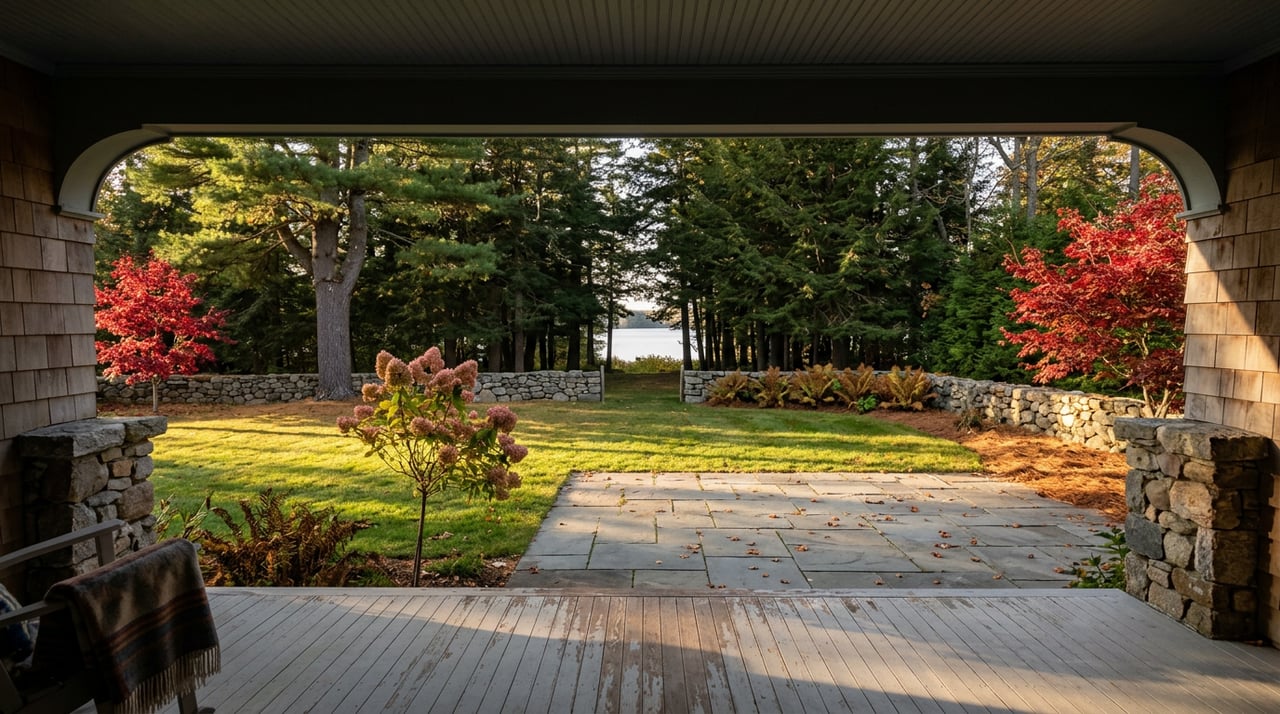
None of this depends on the lake reopening for swimmers, because it never will. The appeal was never really about the water being accessible. It is about a mature deciduous forest and a shoreline that happens to be protected from development because it sits inside a working watershed. Auburn's biggest natural asset became a drinking-water source in 1870, and that history still shapes how people experience it.
A finished loop around Battery Point tends to end the same way for most people who make a habit of it: somewhere to eat that isn't far from Audubon Way.
Auburn Pitts, at 167 Rockingham Road, has been running since 1968, originally as a garage and private club before it grew into the town's default backyard bar and grill, horseshoe pits and all. The kitchen serves through 9 or 10pm most nights, and the venue runs live music most Friday evenings from 7 to 11pm, sometimes Saturdays too, with an open mic on Thursdays.
Auburn Tavern, at 346 Hooksett Road near the Route 101 exit for Route 121, runs a Greek-forward menu, seafood and lamb dinners alongside burgers and steak, with regulars who come back multiple times a month for the fish specials.
The Prodigal Brewing Company, tucked off Old Candia Road, is about as small as a New Hampshire brewery gets, pouring pints Friday and Saturday from 4 to 9pm out of four fermenters. It is the kind of place you find because someone who already lives here tells you about it, not because it shows up on a list of destination breweries.
None of these places exist because of the lake. They exist because Auburn is a town people actually live in, and the walk around Battery Point is one piece of a Saturday that usually continues somewhere with a kitchen open. That is the difference between a lake town built for visitors and a town that happens to have a very old, very protected lake running through it. Auburn is the second kind, and the calendar this time of year, quiet after Duck Race weekend, cooling past bug season, leaves turning along the Yellow Trail, is built for exactly that kind of ordinary use.
If you already live near Battery Point, none of this is news to you. If someone you know is trying to picture what a weekend in Auburn actually looks like, this is closer to the truth than any brochure about Lakes Region living will get.
For questions about property in Auburn or anywhere else in southern New Hampshire, Gail McCarthy is always glad to talk. Let's Connect.
This article is general information, not legal, tax or financial advice. Consult a qualified professional about your situation.
From the first conversation to closing day, Gail delivers thoughtful guidance, responsive communication, and a high level of professionalism. Her experience in both property ownership and brokerage gives clients a practical, informed perspective that helps them move forward with greater confidence.

23 BARBERRY ST HOOKSETT, NH 03106 MON - SUN, 9 AM - 5 PM OR BY APPOINTMENT